
While music and cinematography are often heralded as reasons to love a movie or television show, a less marketed aspect of filmmaking success is production design. A cohesive design goes a long way toward helping a production look and feel polished, whether it’s the set design, the locations, the costuming, or many more elements that have to be concepted from day one. Here are a few examples of K-dramas that are united in all aspects of their production.
The Uncanny Counter
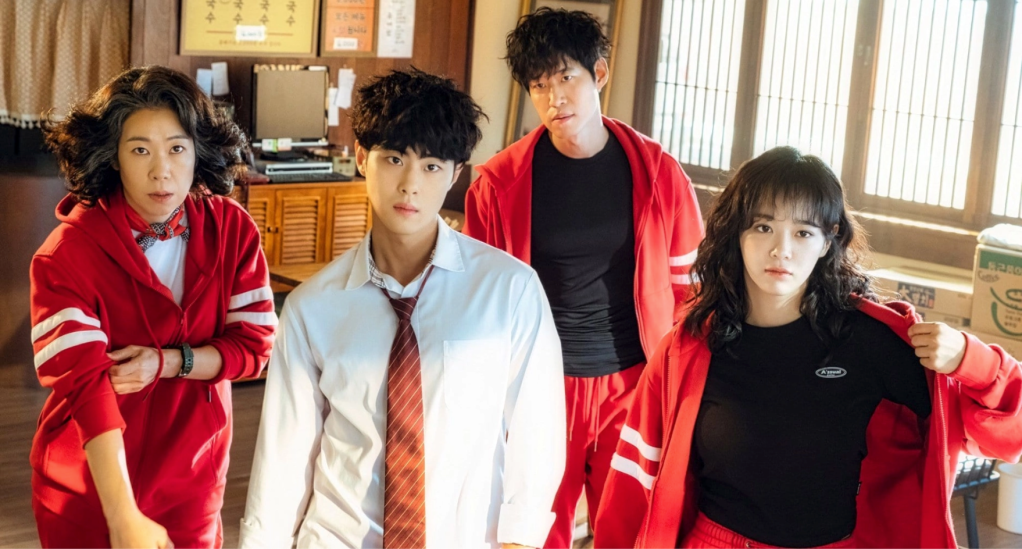
With its webtoon counterpart as a source, The Uncanny Counter keeps itself visually coherent through locations, costuming, and character styling. The establishing plot point is that the four leading characters are coma patients who have been given a second chance by being the hosts of spiritual beings wanting to destroy evil spirits. This gives the members (or “Counters”) respective supernatural strengths, each representing a critical role to round out the team. Strength, divination, healing, psychokinesis and a dash of other powers join forces as a unified front wearing matching red tracksuits.
For a drama centered around a squad, the established home base is critical, but even more essential is the family home when the main character is a teenage boy. Food is what brings these two locations together, as the base is a famous noodle restaurant and a warm meal waits for the protagonist So Moon when he arrives home to his worried grandparents. In cold contrast, the heavenly space where the spiritual beings hold court is awash in bright white light, blurring the edges of possibly relative morality. Familiar to those who enjoy Norse mythology, vertical glowing rainbow lines (“Counter territory”) signify a connection between the human world and the spiritual plane, allowing the Counters to trap an evil spirit and send them to their final destination.
A subtle nod to the hand-drawn source of the story, doodles appear on screen while So Moon is chatting with his friends. An artist himself, So Moon is drawing a superhero story without knowing he will soon become a real-life fighter himself. As revealed in the first episode, the breadth of power that So Moon possesses is beyond even what the others expect from a frail-looking high schooler with a physical handicap, allowing for a visual journey of progress as he hones his powers of summoning Counter territories.
As expected, all the members of the Counter squad have a small or large connection to each other in the past. Although the first season leaves viewers with a cliff-hanger, many of the loose ends tie together, reuniting characters and evoking emotions as the main storyline wraps up. Hopefully this series can be officially picked up for season two and carry with it the production quality of the first season.
Author’s Edit 6/27/23: Season two of Uncanny Counter finished production and will air in July 2023.
Business Proposal
If the relatable characters don’t sell viewers on the series, ambitious scene changes and character insertions litter Business Proposal’s first few episodes, accomplished through its purposeful storyboarding and talented editors. Much of the vision of the show is directly inspired by the webtoon it was based on, lending direction to the silhouettes and placement of characters in and between scenes.
Kim Se-jeong found the perfect starting blocks for becoming the lead actress in her second drama on this list, embodying the hard-working, friendly Shin Ha-ri with all the exuberance the actress already possesses. A far-cry from the toughness of Do Ha-na in The Uncanny Counter, Ha-ri and the whole cast of characters needed to reflect the tone of a romantic comedy while still representing their various positions of social status. The bonus challenge for the costume department was contrasting the style of both the average Ha-ri and her much wealthier alter ego Shin Geum-Hui, whom she embodied for the first portion of the drama. The CEO male protagonist Kang Tae-moo gets to keep wearing his expensive suits in or out of the office, while Ha-ri dances around him as both herself and Geum-hui. Eventually, she goes from throwing on her white lab coat for work and a wig to play Geum-hui, finally emerging as just herself, Ha-ri.
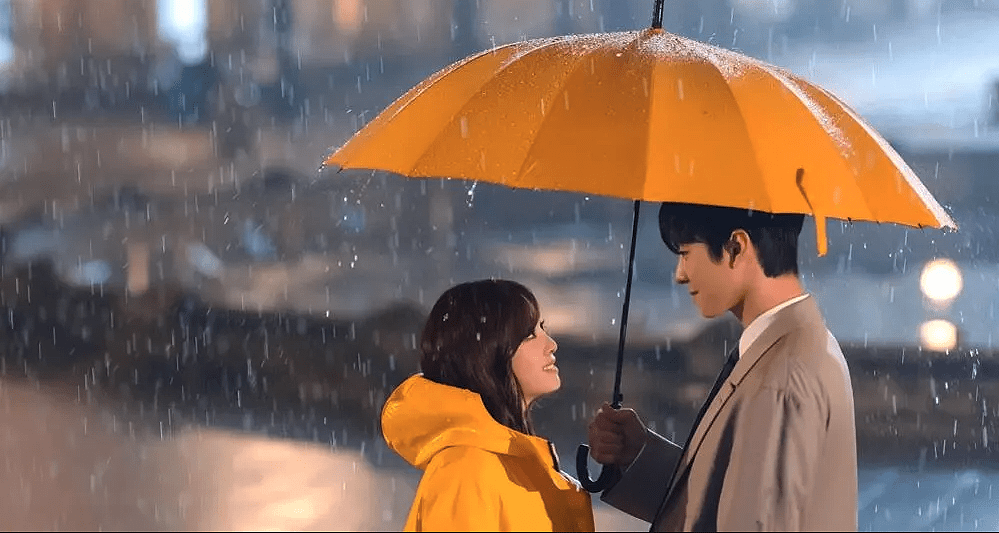
The series doesn’t take itself too seriously, borrowing scenes from famous dramas to include fun Easter eggs for those more familiar with Korean television. Yellow umbrellas and slow-mo shots, accidents to send someone rushing to the hospital, and plenty of fried chicken helped the production keep a lighter tone to suit its genre. Seemingly a farce at first, the show brings in every rom-com trope to satisfy viewers but instead turns them on their head and takes an approach of female agency and respect between partners instead of the over-used “hero saves damsel” tactics. “What kind of show makes the characters get together after just one kiss?” As their relationship blossoms, Tae-moo learns from Ha-ri how to let go of controlling tactics and leans into meeting her where she is.
Squid Game
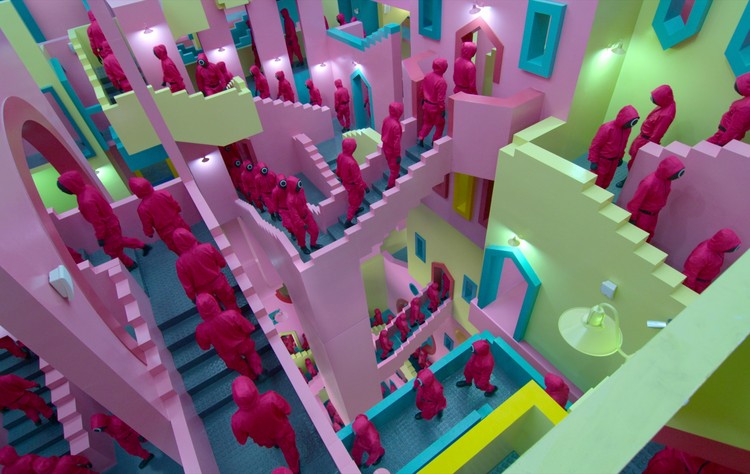
Probably a more obvious addition to this list, Squid Game benefits from uniform jumpsuits and a childhood play environment to achieve a cohesive production. While the games themselves take place in a facility designed to look like a schoolyard, scenes that take place outside of the games enclosure mostly happen at night or in grungy environments to keep a visually dark tone. But this show is no mere child’s play.
What sets this program apart from the typical K-drama is the cinematic approach to the production. Historically, K-dramas were broadcast on television and therefore refrained from nudity and overt sex, even in the “after hours” shows that were not intended for young audiences. These approaches were normally left to the film side of the industry, which often handles darker themes and provides more opportunity for risqué scenes. At the same time, with better access to quality filming equipment and bigger budgets, the thriller genre has been on the rise in Korean primetime slots, allowing for this project to finally be green-lit. Only one sex scene appears in the drama, which won’t be abnormal for international viewers, but will certainly set a precedent for future Korean productions utilizing streaming services.
The strongest takeaways from Squid Game are the props and the costumes. What has stuck in the audience’s mind after taking in the show is the first game played in the series. So far the story had taken a fairly predictable route of a man with a mountain of debt being lured by money into something he didn’t expect. But what shocks both the viewers and the characters is that the normally innocent game of Red Light, Green Light facilitated by a familiar cartoon character is in fact a more final exit than they realized. If a player messes up while playing these games, they die a brutal death. And likely, no one will miss them. In 2021, the swarms of people dressed in track suits and red hazmat suits lent instant recognition to the media that made the largest impact on viewers that year. For Korean viewers, the cartoon girl used in the Red Light, Green Light game suddenly had a different memory assigned to her image, a far cry from her previous place merely decorating children’s textbooks.
The most striking visual is the penultimate scene between the main character and his neighborhood friend, duking it out on the squid game playing field. After years of not seeing each other, Seong Gi-hoon and Cho Sang-woo fatefully meet on the floor of the games facility wearing matching tracksuits, both desperate for cash despite the opposite directions their life took them. “When we were kids, we would play just like this, and our moms would call us in for dinner.” After the blood bath of the previous rounds, the final titular game takes place on the same field that started it all with Red Light, Green Light. “They’re all dead. Everyone who was here back then, except for you and me. We’ve come too far to go back.” Now the last two players standing, their paths stand on the edge of both a real and metaphorical knife as the clouds darken the arena and rain falls down upon them. “Good rain knows the best time to fall,” says a wealthy spectator, noting the appropriate crossover of the outside world splashing into a previously idyllic play area. The brightly colored children’s playground has been washed away by the dark tones previously reserved for the world outside the games facility. In the end, all of this desperation and death had been merely for the viewing pleasure of wealthy men, masked in gold and relaxing in vibrant, lewd splendor. No amount of paint or finery could hide the injustice.
W: Two Worlds
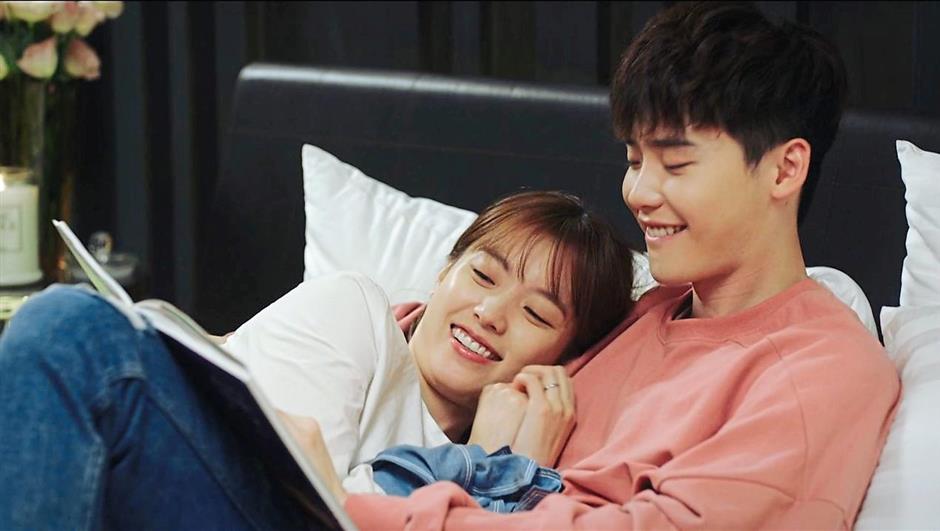
Leaning hard into its concept of being half a manwha and half the real world, W: Two Worlds artfully cues the viewer by deliberately lighting its “other world” scenes to evoke a line art appearance. Placing lights behind the talent and straight on their faces creates a harsher edge to their profiles and contrasts them from their backgrounds, coupled with increasing the saturation and deliberately shooting in colorful environments to provide the feel of a hand-drawn comic. This pre-planning allows for the editor to more easily guide the viewer toward following along as the protagonist moves between worlds.
As the story unfolds, it becomes more clear that the two worlds largely mirror each other. Subtle name changes are the main differentiator, but that is due to the fact that the other world is directly drawn by artists’ hands using real world references. But the largest differentiator between real world and manwha is how fancy the apartment is. The real world tends to be just that, as the female protagonist Oh Yeon Joo is a medical resident living with her mother in an average apartment. The glitz and glamor tend to stay in the manwha side of things, with the male protagonist Kang Cheol enjoying his penthouse apartment and sports car.
The largest visual crossover between worlds is the eventual overlap of the villain with Yeon Joo’s father, the artist behind the manwha world. This signifies the official blurring of lines between the worlds as the villain learns to jump into the real world and pursue the protagonists. With no one safe and their worlds upended, Cheol eventually must leave behind his glitzy life and go back to his middle class roots while on the run from the police. What matters most to him is revealed during his time as a fugitive, allowing him to eventually leave his own world behind and become “a real boy,” getting to live a normal life with Yeon Joo.

 Drama Queens